Tesshin spoke to the group this week about the structure of the mind. He compared the 2500 year old Buddhist/Hindu understanding of the mind with the more recent Western conception starting with Freud and extending through modern neuroscience.
Understanding the map of the mind is important because it allows one insight into why certain problems and reactions keep reoccurring. Our spiritual pursuit is all about understanding the mind so that we can alleviate suffering from these reoccurring problems.
Buddhist teachers in the West commonly talk about overcoming the ego as a goal of practice. But what exactly does the word Ego mean? Tesshin speculated that the term “Ego” may have been over interpreted by translators bringing the Dharma to the West. In the Freudian construct, the mind is divided into specific parts called the Ego, Id, and Super Ego. The Ego is the part of the psyche which deals with the rational world. It is the thinking and deciding part of our consciousness. Commonly it is called the ‘I’ of the psyche. So when Buddhism teaches that the key to enlightenment is to destroy the “ego,” it should not be surprising that students misinterpret Buddhism as nihilistic.
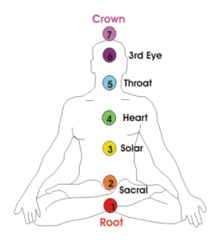
Tesshin suggested that there is better non-dualistic way to map our consciousness and existence. Many Eastern traditions have the concept of chakras. Each of the chakras represents a part of our total existence. For instance, the Root Chakra centers on survival and would be most associated with our primitive limbic system. At the other end of the spectrum is the Crown Chakra which represents our ability to be fully integrated in life and in spirit. This would be equivalent to the prefrontal cortex in the brain.
In the chakra tradition, we do not try to suppress anything or eliminate anything as all chakras comprise our existence. The symbols of the chakras remind us that we cannot exist without each aspect. (survival, pleasure, self, love, expression, wisdom, actualization) This is why chakras mediation is considered non-dualistic and very different than the mind/body dualism commonly understood in the west.
Tesshin wrapped up by reminding us that the goal in mediation is to understand and penetrate all of the chakras from highest to lowest. Students tend to over intellectualize meditation and thus no real progress is ever made. The way to prevent this is to strive for unity and balance between all aspects of existence!
This week’s image courtesy of wikipedia
Leave a Reply