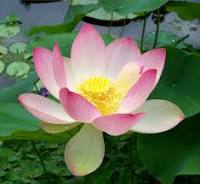
Tesshin recounted this week the “Flower Sermon” which is a famous story in Zen Buddhism. In this story, the Buddha was about to give a talk, but instead of speaking, he simply plucked a lotus flower and held it aloft. Of all the accomplished students attending, only Mahakasyapa reacted – he smiled. At this point, the Buddha states …
I possess the true Dharma eye, the marvelous mind of Nirvana, the true form of the formless, the subtle Dharma Gate that does not rest on words or letters but is a special transmission outside of the scriptures. This I entrust to Mahākāśyapa.
Zen Buddhism now uses this story as a Koan. So what is this Koan trying to teach? First, it is good to have a bit of background on what is happening here. A Lotus flower grows in the mud of a pond. When the Buddha plucked the flower, everything came up. The pretty flower, but also the ugly roots covered in mud. What was Mahakasyapa smiling at? Did he realize that the flower is nothing without the mud? What does it mean when mud and flower is really the same thing? We smile today because we see the constant pattern of the Koan – namely no duality.
There is a second aspect of this story which Tesshin focused on this week – namely the wordless transmission which Zen is famous for. The Buddha raises a flower, Mahakasyapa smiles, and “transmission” happens. Tesshin asked us what was actually transmitted. Of course, the answer is NOTHING. Nothing was transmitted because we already exist and have “suchness” – we just do not realize it yet. The Buddha raised a flower – he raised mud – he raised roots – and only Mahakasyapa realized it. He realized it and smiled. BANG! Everything passes – but nothing passed. All Buddha stated is that Mahakasyapa “got it.”
Tesshin next talked a bit about formal Zen transmission. When a teacher transmits to a student, it is essentially one generation recognizing itself in the next generation. It is said that the new generation is the “Dharma Heir” to the previous generation. In Japan this is called “inka shōmei” and it roughly translates to “the formal recognition of Zen’s deepest realization” Tesshin was emphatic at this point, however, that the teacher is not giving anything to the student. It is merely recognition. This is an important thing because as we come to sit each week, we must perform the work of realization ourselves. The teacher is merely present to help. I think the best way to look at this is like a coach of a sports team. The coach is critical, but they never participate in the game. It is only the athletes performing the real action. However there would be ZERO success without the coach.
Tesshin concluded by encouraging us to be steadfast in our practice. He reminded us about the custom in Japanese gardens where there is a bamboo pipe dripping water onto a rock. It is said that it takes three years for the water to make a mark on the rock. This is like our practice! Slow steady dripping to make a mark on our consciousness.
Leave a Reply