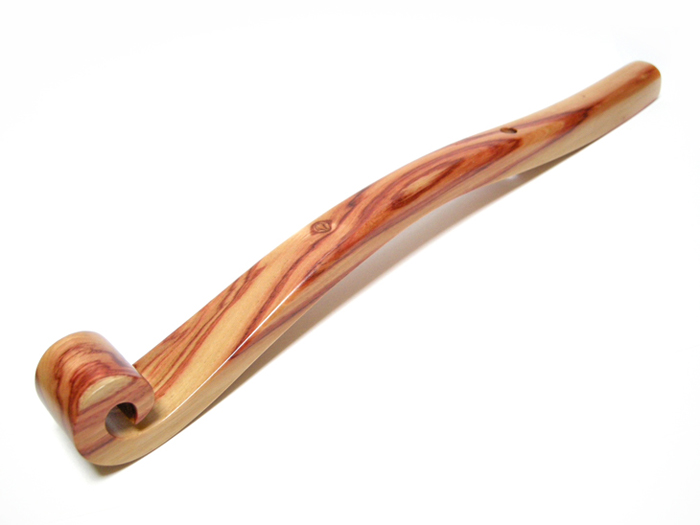
Tesshin opened his talk this week by describing the different “sticks” used in Zen training. There is the large stick which he taps us on the shoulders with. This is called the Keisaku or the “encouraging stick” and is used to increase our energy during a meditation session. However, this week, Tesshin focused on the smaller “teaching stick.” In Zen, this is called Kotsu or the “Bone” – why is this?
If we look at this stick when Tesshin holds it during Taiso (Dharma talk) we can see that it looks like a spine with a head atop it. The message is clear! To do Zen, we really need nothing more than a spine (right posture) and a head (right mind). Everything else is optional.
On a deeper level, the Kotsu is another reminder that we must cut to the bone in our practice and eliminate everything which is a distraction and not necessary. Zen commonly talks about getting to the “marrow of the issue.” Which issue is this? Namely the issue of life and death and why we are here in the first place. It most Zen temples there is a “Gatha” or saying which is read every night…
Let me respectfully remind you
Life and death are of supreme importance
Time swiftly passes by and opportunity is lost
Each of us should strive to awaken
Awaken!
Take heed, do not squander your life.
The bone in the teacher’s hand is clear reminder at what is at stake and not to squander your precious life with distractions.
Tesshin next used Zen archery as another example of getting to the marrow. In Zen the act of shooting an arrow is a metaphor for the entirety of life and the crucible of practice. It is commonly said that there is “One Arrow – One Life” All the practice, preparation, and training leads up to the one moment when archer, target, and arrow become one. Everything happens in this one moment. Do not look to the future, do not look to the past – just this one moment!
Tesshin next noted that this concept is also very common in Japanese culture. When people meet, there is an idiom “Ichi-go ichi-e” This roughly translates into “One Meeting – One Opportunity” It describes the cultural concept of treasuring this very moment with the person you are with. Tesshin wondered how many of us think about everything BUT the person we are with in normal social situations. The Japanese consider the meeting as the most important thing in that moment as they may never meet that person again.
Tesshin wrapped up the talk by stating that all of these symbols serve as a reminder to be present in this moment. Meditation is all about training the mind so that we can control it and put it where it needs to be in every moment. Stop wandering – stop regretting the past and worrying about the future. The moment to act is NOW.
Leave a Reply