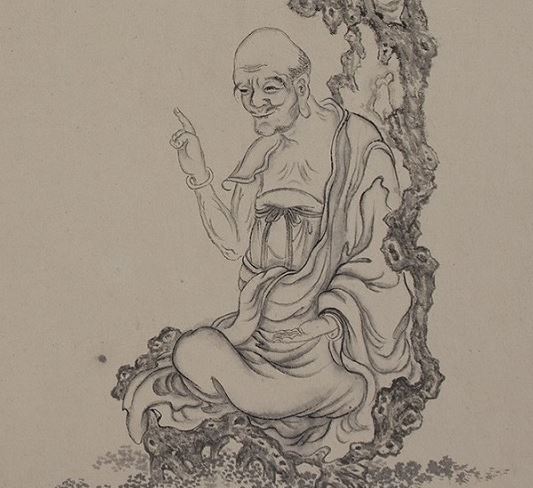
Tesshin used this week’s talk to continue our study of “One Finger” Zen. He touched on this topic earlier when teaching on the story of “Gutei’s Finger.” This week, Tesshin continued the exploration of One Finger Zen by talking about Blue Cliff Record Case 19. (A copy of the Blue Cliff Record can be found here.)
This case is striking because it is a single verse…
“Chu Ti (Gutei), whenever he was asked a question, only raised a finger.”
Not much to go on here at first blush, but Tesshin remarked that we could spend an entire week’s retreat plumbing its depths of this one sentence – such is the way with Koans!!
In order to help the student, a Koan normally comes with a verse. Below is the verse or commentary …
When a particle of dust is raised, it comprises the great earth.
When a flower blooms, the world springs forth.
But when dust is not yet raised, and a flower has not yet bloomed, how can it be seen?
Therefore, I say, it is like cutting a skein of thread: with one cut, it is all cut; or like dyeing a skein of thread: with one dyeing, all is dyed.
Now, if you cut off all complications, and bring forth your family treasure, then you comply everywhere with high and low, and there is no difference between front and back; each one will be fully manifest.
If you are not yet so, look at the lines below.
Tesshin next gave the context and commentary of this story. Gutei was a monk practicing in 12th century China. His original method of teaching came down from Bodhidharma who taught “non teaching.” Basically in this style of teaching the master says nothing and allows the student to do almost all of the work of discovery. Also, like Bodhidharma, Gutei would be known to sit in silent seclusion for long periods of time.
There is a famous story where a nun whose name roughly translates to “reality” visits Gutei. (whoh! if the student’s name is reality – we know something big is about to happen!!) She first follows the forms when addressing a master. She circles the master three times, however she fails to take off her rain gear. As it was raining outside, she was completely drenched and we can image her dripping everywhere. She then states, “If you will speak (e.g. teach the Dharma) I will take off my rain hat.” Gutei says nothing – after all what is there for him to say? Anything he says will only distort reality! The nun repeats her query two more times. Finally the nun gives up and turns to go. At this, Gutei breaks his silence and says, “The hour is rather late: would you stay the night?” The nun retorts, “If you speak, I will stay.” At this Gutei resumed his silence and the nun left. Now, our first reaction may be that the master was dismissive of the nun, but we know this is not the case as he invited her to eat and stay at the temple – a great honor!
What happens next is interesting. The master starts to consider the exchange. He is charged to use “skillful means” to bring the Dharma to all who seek. The nun is very close to full enlightenment. The master followed the forms of Bodhidharma – but it did not work! The nun left! He failed! He was obviously not skilled enough to teach an accomplished nun. There must be more to learn about the Dharma. Gutei decided he must leave the temple and find a more accomplished master to teach him what he does not know. However, before he left he had a dream where spirits of the mountain (Zen temples are commonly on mountains protected by mountain spirits) came to Gutei and told him not to leave the temple, but a Bodhisattva would come to him and teach him what he lacked.
At this point, Tesshin paused and recounted that his master Ban Roshi had a very similar experience. His master, Harada Roshi told Ban Roshi that the new abbot of Tetsugyuji temple would be a student who traveled from afar across the wide sea. This student, of course, was Tesshin. It would appear that the theme of spirit visiting during dreams to provide advice is common in Zen. (Tesshin and his teacher’s backgrounds can be found here.)
Tesshin then continued with Gutei’s story. The newly arrived master (T’ien Lung) made the failure teaching the nun Gutei’s new koan. One day, when working the Koan, the master simply raised his finger in response and BANG! Gutei got it and entered a deeper state of enlightenment. From that point forward, he no longer reflected Bodhidharma, but the “One Finger Zen.”
So what are we to make of this story? Tesshin remarked that originally Gutei taught Bodhidharma’s Zen. Then T’ien Lung showed him something else and he started teaching One Finger Zen. But who is Gutei and why does he not teach “Gutei’s Zen?” What Gutei realized is that Zen is Zen and his ego does not need to create something new. He simply echoes wisdom. He is a messenger, not the message! Adding to Zen destroys Zen! Tesshin emphasized, sometimes we simply have to get out of the way so that the truth we have comes out clearly. He reminded us every sentient being is already perfect and that we are already enlightened – we just need to discover it and then show it. We do not need to CREATE it; we just need to see that it is already there. For Gutei, it is the same – he does not need to create new teachings – he simply understood what was needed when.
Leave a Reply