Tesshin remarked that this is an important week in the calendar of many faith traditions. For instance, Passover is a celebration of liberation. Easter is a celebration of rebirth. Ramadan is a commemoration of Muhammad’s first revelation. However, this year Tesshin noted that there is a difference and a paradox. Now we have liberation, rebirth, and revelation, but with significant restrictions. In the Jewish Sedar, the tradition is to normally welcome everyone -but this year, we can welcome nobody! For Easter we celebrate resurrection, but this year wherever we look we see death and body counts. This dichotomy creates confusion and grief. How do we deal with this paradox?
Here Tesshin was clear – through mindfulness we look at it deeply. A good deal of our suffering comes from our inability to reconcile disparate things. We feel that we have no control. In the United States we are used to freedom, but now we don’t have it. This is new for us. It just does not jive with our culture. We all experience a strong anxiety over loss of “agency.” Tesshin remarked that to mitigate this anxiety, we need to look deeply and understand the fear.
Tesshin had a conversation with an associate this week which really exemplified this fear of loss of control. Tesshin noted that this totally normal friend has turned into a “full blown prepper” in reaction to the Covid situation. She is collecting seeds, storing food, has a “Bugout Bag” and is even considering buying property in the woods. It is clear that she is trying to gain control of a situation where total control is unrealistic. All Tesshin could do is listen to her extreme state of anxiety and be supportive as possible.
So how do we use our training to help ourselves and others? From the sutras, we learn that everything we experience is “fumbetsu” or noise and distraction. If we really understand this, then there is no real paradox in what is happening to over the past few months. The lack of control is fallacy. It is all “Mu” or “this and that!” Zen teaches that all we really have is THIS moment. Tesshin reminded us that while this sounds simple, it takes a lifetime of reflection and zazen to really manifest this understanding.
So, does this mean we act in a callus way when we see suffering? Do we tell a Covid patient that their suffering is fumbetsu? Can we cure disease with Zazen? Of course not!! Suffering is real in this world – we only need to look at the first Noble Truth!! The difference is that we do not attach to the suffering. Suffering can never be the totality of existence – it is just a part. Recall Tesshin’s point last week when he compared suffering to the crashing waves on the SURFACE of the ocean. Our existence is the abiding equanimity of the entire deep deep ocean. The ocean cares little for the noise on the surface! It is the same way with suffering – it is there, but it is a small part of the totality of existence. The waves come and go but it is the ocean which is timeless. It is from this place of calmness we can engage others with compassion and support during this challenging time.
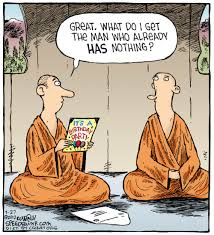
On a more cheerful point, Tesshin remarked that this week is also a time when we celebrate the Buddha’s birthday. At Zen temples it is common to see a baby Buddha pointing up with one hand and sideways with the other hand. This symbol is a reminder that in both heaven and on earth there is only this moment.
Tesshin then sang the “happy birthday song” to the Buddha and everyone in the sangha joined in with much giggling and mirth! 😊
Leave a Reply