While we essentially finished off the book of Zuimonki, Dogen told this story in it that is basically a koan. As soon as Roshi brought it up, he realized it needed to be its own discussion. Dogen says:
Remember the story of Ryosui who visited Zen Master Mayoku. The lecturer Ryosui visited Mayoku, a disciple of Baso (a quite famous Zen Master). Upon seeing Ryosui coming, Mayoku took a hoe and went to hoeing up weeds. Although Ryosui went to where Mayoku was (where he was working), Mayoku paid no attention to him, went back to his room, and shut the gate. Ryosui visited Mayoku again the next day, Mayoku shut the gate again.
Ryosui knocked on the door, Mayoku asked, “Who is it?” “It’s Ryosui.” When the lecturer called out his own name, he suddenly attained enlightenment, and said, “Master, do not deceive Ryosui. If I had not come to see you, I would have been deceived by the sutras my whole life.”
When Ryosui went back, he gave a speech to his class: “All you know, Ryosui knows. What Ryosui knows, you don’t know.” Then he quit giving lectures, and had his people go and leave for good.
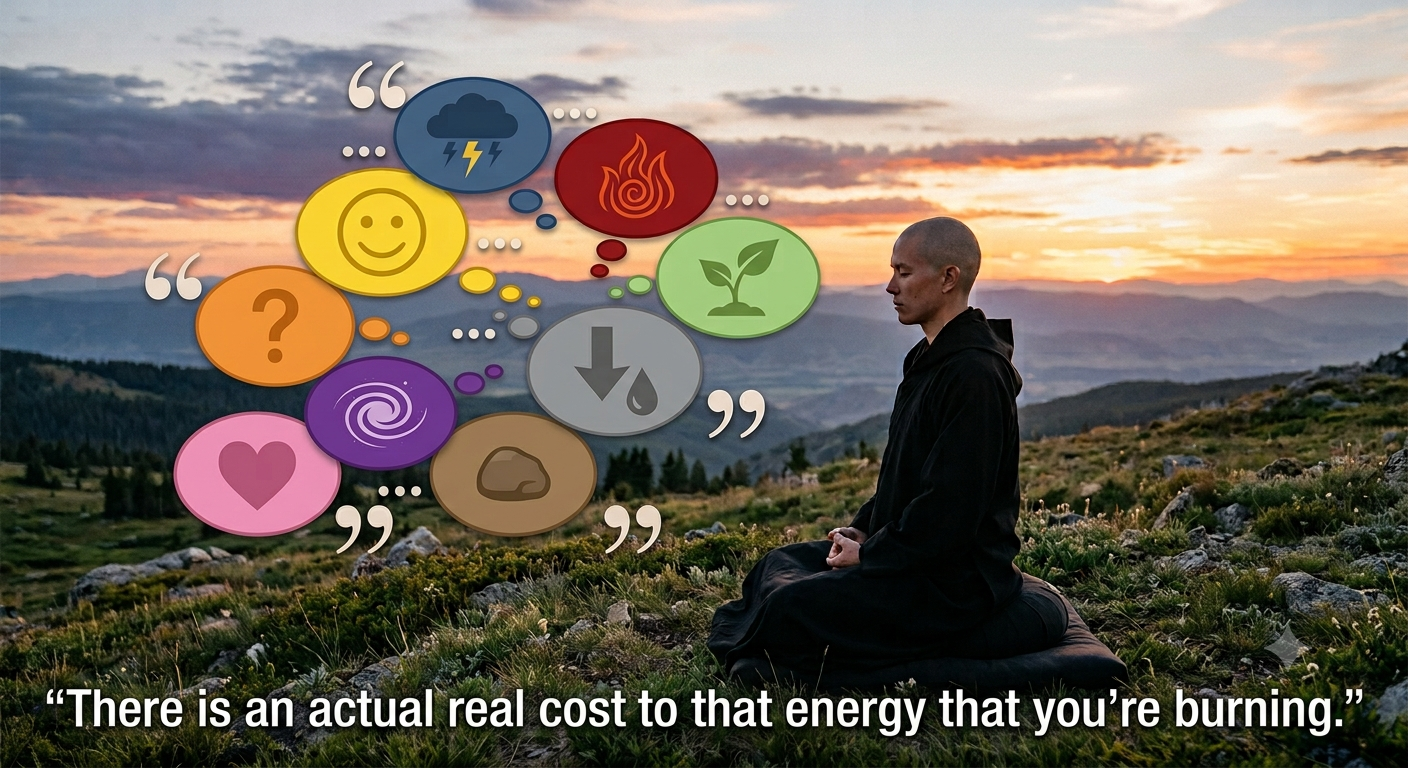
When we sit, there is something called the Zeigarnik Effect in our prefrontal cortex. We have the capacity to have multiple narratives running at the same time, and there are a whole variety of narratives on any given moment. We have part of our brain going, “Oh eggs are on sale, I’d better pick them up on my way home,” and “It’s my sister’s birthday, I’d better call her to wish her a happy birthday,” and “I have to make an appointment for my dog.” We have those things that keep popping up.
Then we have these deeper unconscious/subconscious narratives which are constantly running but only occasionally surface, and they can be quite harsh. Very deep in our mind we can have this ongoing narrative that talks to ourselves about how mean it was that my mommy said that thing to me when I was five, and “What’s wrong with my neighbor, they can’t take out the garbage on the right day,” and “Why is it my boss doesn’t appreciate how valuable I am and give me a raise for the money I deserve?” We have all these judgments, often critical, on our life, on the world.
Then there is another narrative potentially that is running that says things focused inward like, “Oh my gosh, I wish I could get rid of these bags under my eyes,” or “I wish my nose was smaller,” or “I wish I could get rid of my belly.” That is a dialogue that just runs and runs.
Now each of these narratives actually requires energy to maintain itself. ~25% of the energy that we use in a day goes to our brain, and these narratives actually eat up energy throughout the course of the day. So when we are eating, we are actually feeding these narratives, whether we like it or not.
Then others have narratives like, “What’s my life about?” “How do I become happy?” “How do I become enlightened?” “What does this sutra have to do with me?”
There is another potential one that also could be running, about “How lucky am I to be having the life that I have?” “How amazing is this universe?” “I love so many people in my life I can barely contain myself.” All these things are running potentially, and we are paying energy to keep them running.
This is a challenge for us when we’re trying to sit in zazen and be in pure focused concentration, because we all have these things running all the time. Well how do you manage that? How do I get into pure focus, pure concentration? Some of them are easy. Like the short-term chore list, that is relatively easy—just do them before you come here, before you sit. If I wish my sister a happy birthday before I sit, that is the Zeigarnik Effect, that actually closes down and shifts energy to other things. So that short list that keeps popping up, you can take care of those things before you do your deep concentration. That part is easy. You have to manage it.
The other part is a little more challenging, because we have been running those dialogues for so long. They are not so easy. It is not just a phone call, it is not just an email, it is not just a little effort to shut those things down. People often say, “I don’t understand why I’m so tired all the time.” “I just don’t get a good night’s sleep.” “I’m just exhausted.” “I don’t feel energized.” “I’m perpetually fatigued, why is that?”
It is the same reason why in your house if you left all the lights on all the time, your electric bill would be extremely high. It is just consuming energy. Whether you are using it or not, it is there. It is consuming energy, and consuming energy. Month by month you are going to pay that bill, then pay that bill, then pay that bill. There is a cost. There is an actual real cost to that energy that you’re burning, and there is a real cost to this negative critical dialogue that is running constantly in our brain. It is a very real cost, not theoretical. It is actually taking energy. It is actually creating stress. It is actually generating cortisol which is a toxic hormone in our body. It is physiologically harming us. There is a cost we’re paying by having this thing running all the time, and we’re not fixing it.
It really comes down to us getting to a point when we say, you know what? I don’t want to pay that cost anymore. It is not serving my life. It is not making my life better. Other people can kind of intuitively feel it anyway probably. So I want to shut that down, somehow. Let me figure out how. We will put this to the side for a moment.
Then we come to this other really interesting dialogue about “Who am I,” “What am I,” “How do I become enlightened?” Many koans have a ‘turning phrase’ where someone says something to someone else and they become enlightened. People often reply, “Yeah right!” “That’s very convenient!” “They just suddenly became enlightened? That is not very likely.”
Roshi thinks the older we get, hopefully the more and more we have these experiences in our life where we can go back to a very specific time and place where someone said something to us and it changed our life. It may not be enlightenment, but it changed our life in a positive way, in a good way. They said something and all of a sudden the world and your life opened up a bit. That’s a turning phrase. So when people want to look at these koans and say, “How is it that this guy just calling his own name became enlightened??” There is a reason for that, it is a very real thing, and it has to do with having that conversation active in your brain. And it is because that is active, when you are in the right time and the right place with the right person, that is what ‘turns it on.’
Over the years Roshi has shared some of those things that people have said to him that have changed his life, with our permission he will share another one that he does not think he has shared with us before, if it is ok. He feels it is a little embarrassing but will say it anyway. When he graduated college, he moved to LA to work for several years. One of his first jobs was when a classmate of his who lived in LA called and said there is an opening for a Personal Assistant at the Mark Taper Forum, a big theater in LA. They have this guy Joe Chaikin coming and he needs a Personal Assistant, and his friend thought he’d be great for it. Joe Chaikin is not a household name, but in the 60s in the performance art world he was something special. His best friend was Sam Shepard who some may know, he was a playwright. Shepard often says before he met Chaikin he was just a two-bit actor, and it was his friendship with Chaikin that turned him into an artist. So again in the 60s he was something special.
Then in the 70s, he had a heart attack which left him with aphasia. Aphasia is this condition where your brain is working fine but the wiring is all messed up and you can’t speak clearly anymore. You speak in grunts or in single words like “up,” “there,” “please,” like that which, for a performer was basically the end of Chaikin’s career. You can’t do Shakespeare if you have aphasia, you can’t do anything. He had a hard time. So his best friend said, “Maybe I can help,” and Shepard wrote him a couple of one-act plays for a person with aphasia so that Joe could start to perform again and travel the world since he was quite well-known, and make a living and support himself. He thinks one of them was called Fallen Angel or something like that. So he was at the Mark Taper doing a special workshop and doing these shows, and he hired Roshi to be his Personal Assistant during that time.
Roshi really liked him, he really liked Roshi, and Roshi thought everything was going great from his perspective. Roshi was in his mid-20s, he had graduated from a prestigious university, he was part-time faculty, he was “hot stuff.” Apparently, he wasn’t aware of it at the time, he let everyone else know that he was “hot stuff” too. It was like if you have ever known anyone that has graduated from Harvard, they always kind of slip that in, “I went to Harvard,” “I went to Harvard.” But he felt he was really sharp, and let people know it.
So he was working with Joe, and maybe a week in or so they were having dinner, and he remembers this like it was yesterday, every single word, every single moment. He reached over, put his hand on Roshi’s arm, turned to Roshi, and said, “Paul, …” “to…” “know…” “eve-ry-thing, …” “to…” “think…” “you…” “know…” “eve-ry-thing, …” “is…” “not…” “interesting.”
You could hear the ‘whoosh’ of all the air coming out of the hot air balloon and that thing crashing to Earth really fast. Roshi was literally speechless for days. That was a ‘turning phrase.’ Nothing was the same for him after that. “To know everything, to think you know everything, is not interesting.”
And it reminds him of what Dogen talked about that we shared last week when he basically says that it is such a privilege, an incredible privilege, to be able to sit and listen to the dharma, to just let wisdom come in. You don’t have any responsibilities, you don’t have to do anything, just to be able to sit and listen to wisdom, what an incredible thing. That is how you should spend your life. Same thing.
Roshi was working in Florida all this week, and came back last night. The people he was working with are incredible people, medical researchers from across the country. When you go out onto the street and just deal with the ‘normal’ folks, everywhere he turned they were on fire about Fauci. On fire! They couldn’t contain themselves. He didn’t even know these people and they would just come up to him and start lecturing him about what it was all about. He sat there and thought, “Wow, to be so sure that you understand something, to have no curiosity, no desire, just to have absolute certainty about something you know nothing about.” Not only did he feel it was boring to listen to, but as he was listening to these people, for him he could see the flames popping up around them, like they’re sitting in hell. They are burning up in hell. There is nothing full of love or joy or curiosity, nothing ‘good’ about being so certain, and being so angry, and wanting revenge. They are living in their own manufactured hell. Just no desire to understand. He felt so sad for all of them. So on fire, so certain, so sad.
Again, it is this narrative that they cannot liberate themselves from that is eating all this energy, and keeping them in samsara and this cycle of pain and suffering, and they cannot escape it. From their own expectations, their own attachments, their own certainty about what is happening.
So when we see Ryosui, here is a guy, a lecturer who teaches the sutras, this guy who knows his stuff. People come from all over to listen to him. In theory that is the part of the brain that you would think is going all the time, but he has this other part. Clearly it is like something is missing. “I know the sutras, I teach the sutras, but I’m not living the sutras. I’m not the embodiment of the sutras. And I know from my understanding the sutras that I’m not ‘there,’ there’s something missing. So that is why he goes to Mayoku trying to become enlightened, trying to bring the sutras into his life. Then the other teacher sees him coming, and even that person keeps him at arms length. So the sutras are keeping him at arms length, this teacher is keeping him at arms length, he keeps shutting the door on him, and that part of the brain is getting judgmental and critical and angry because there is no release from that. This other part of the brain is saying, “Why? What’s going on? I want to understand, I am curious, I want to become…” He wants to resolve this dichotomy and what’s not right.
So when he is asked “Who is it?” and he says, “Ryosui!” he calls out his own name, and says “Oh my gosh, that’s the resolution! It is not in the sutras, it is not in the teacher, it is here! What the hell am I looking for?? It is HERE! The sutra is HERE!” Roshi whacks himself on the chest repeatedly with the kyosaku stick for emphasis. “In THIS body! At THIS moment! With THIS breath! What am I looking for? THAT’S why there is a distance! Because I keep looking for something that we’ll never find. Because it is here. “I’m looking for a teacher”? He can never teach me anything because it’s here. Because that thing is so curious and so open and so searching, HE IS READY. And the teacher knew enough that that’s what it would take, to have that turning phrase. That he would actually give himself the turning phrase. He was so primed for it.
That is when he says, “Everything you know I know, but what I know…” You haven’t been enlightened yet. I finally have had this moment of understanding. And that’s going to be all of your journeys so get the hell out of here. Because there is nothing I can tell you, I can’t give you that experience. So leave. And never taught again.
So the question for all of us is, which parts of the brain that are taking up all of our energy are we going to turn on and turn off? Those moment-to-moment things that distract us from our meditation, they’re manageable. But we have to make the decision to call our sister, and make the vet appointment, and take care of all those things.
Now these other things, “How do I turn off that constant critical thing where it’s critical of the world, critical of myself, that certainty that something is wrong, and I am right, and I know the difference, and I cannot liberate myself from that running thing that is exhausting me?” “How do I turn on that dialogue of curiosity and desire to live the dharma, and the desire to live in wisdom and love?” “How do I turn that exploration piece on?” Because THAT is what primes us all for that moment of enlightenment, for that moment, for that thing we’re all seeking. But we have to make the distinction and the choice: which are we going to feed? Because they are mutually incompatible.
That is our process, and that’s what this koan is about. Again, Chaikin, when he said that to Roshi, if he was purely in the judgmental “I know everything” phase, that thing that he said to Roshi would’ve angered him, and he probably would have quit. But there was just enough curiosity, just enough consciousness, just enough vulnerability, and insecurity, that that could land. So it is not a matter of, “I’m going to enlighten myself,” “I’m going to let all this love in,” “I’m going to turn my life around.” No! It is just putting ourselves in a position where when we sit, when we hear wisdom, when we hear the dharma, when we hear things, all we have to do is prime ourselves to a point that we are ready to receive it, and be impacted by it.
That is our only job. It is not impossible. And that is how we get out of hell.
Leave a Reply