Tesshin Roshi thought it would be “fun” to go back to a text we looked at a while ago during the anniversary of Keizan’s passing. There is a lot happening around Keizan, and Keizan is an important ancestor of ours, a student of Dōgen. Around two years ago was in a way the Keizan year, with a lot of attention around him. Keizan’s one big contribution in terms of text is the Denkōroku, the Record of the Transmission of Light. Essentially, it is a fascinating text because it goes through all of our ancestors—or patriarchs—going teacher-student, teacher-student, teacher-student through our lineage with one story and one kōan assigned to each one. Roshi thought we would jump into the middle of this, particularly looking at our great Chinese ancestors. Of course, the first great Chinese ancestor is Bodhidharma, who brought Buddhism to China and is also really the founder in many ways of our practice of zazen. What Roshi wanted to look at today is Huike, who was his student, and who would become the second patriarch.
When we look at our history, we have so many fascinating teachers with very different, colorful lives. But really, when we look at Shakyamuni, for example, he did not have a bad life. He was born into luxury. He had these existential questions that he was trying to deal with. He left the temple as an already formed young man. He engaged in all of these spiritual practices, which were really tough on his body, really harsh. But let’s be honest, they were self-inflicted. He wanted to fast. He wanted to do all these things to his body because he wanted to become enlightened; he wanted to answer these questions. And then when he became enlightened, he was the great Buddha, so he had basically surpassed a lot of his pain and suffering for a very long time. He had some troubles—people tried to kill him occasionally and things like that—but he dealt with it and lived a pretty peaceful life overall.
But that is not the case for all of our ancestors. One of the extreme cases is Huike, the second patriarch, because none of his sufferings were his fault. They were all his karma. We hear Roshi say this all the time: your karma is not your fault, but it is your responsibility. Huike had all this karma that basically set his entire life up for just being battered over and over again. Heartbreak. Even before he was born, his karma had set him up for this.
For example, we see this in the Bible a lot, where couples cannot conceive. His parents were the same. They desperately wanted to have a child, but they could not. It just was not destined to be. But miraculously one night, as the story goes—and these are all stories—his mother and father were in their room, and this great light entered. He was conceived during the night of this big light, and he was actually named after the light. His original pre-Buddhist, pre-Zen name was Light. But when he was born—and Roshi noted he can relate to him, because it was the same with his own parents. They could not have a child for a very long time. In their case, they adopted, and then “the great light entered their bedroom” and Roshi was born. So he can appreciate that trying, trying, trying, and then having it happen.
In Huike’s case, maybe it was the light. He was not a normal kid. His karma did not set him up for being normal. So when all the other kids were playing and having fun, he was very ruminative, contemplative, reading as a young kid, a very deep thinker. He was not really enjoying life very much. In his deep reading, he came across Prajna Paramita teachings about emptiness. As a kid, he was very, very moved by this whole concept of emptiness. This is not normal eight-year-old behavior. But he was destined to be this spiritual teacher and leader, with all the things that come with that.
His teacher at the time said, “Yeah, you shouldn’t be here. This isn’t for you. You need to go south and look for a spiritual teacher.” He wandered, found a teacher, and wound up living in isolation for half a dozen years in deep meditation as a teenager. During one of these deep meditations in a cave, much like Bodhidharma, a vision came to him—a celestial being came to him that said, “You need to continue going south to find your teacher.” He continued south, found another teacher, and trained with that teacher for a while. Then that teacher said to him, “I’ve taught you as much as I can. You need to go to find Bodhidharma,” who was a great teacher at the time in the south. So he went further south, very unhappy, obsessed with finding the truth, finding reality.
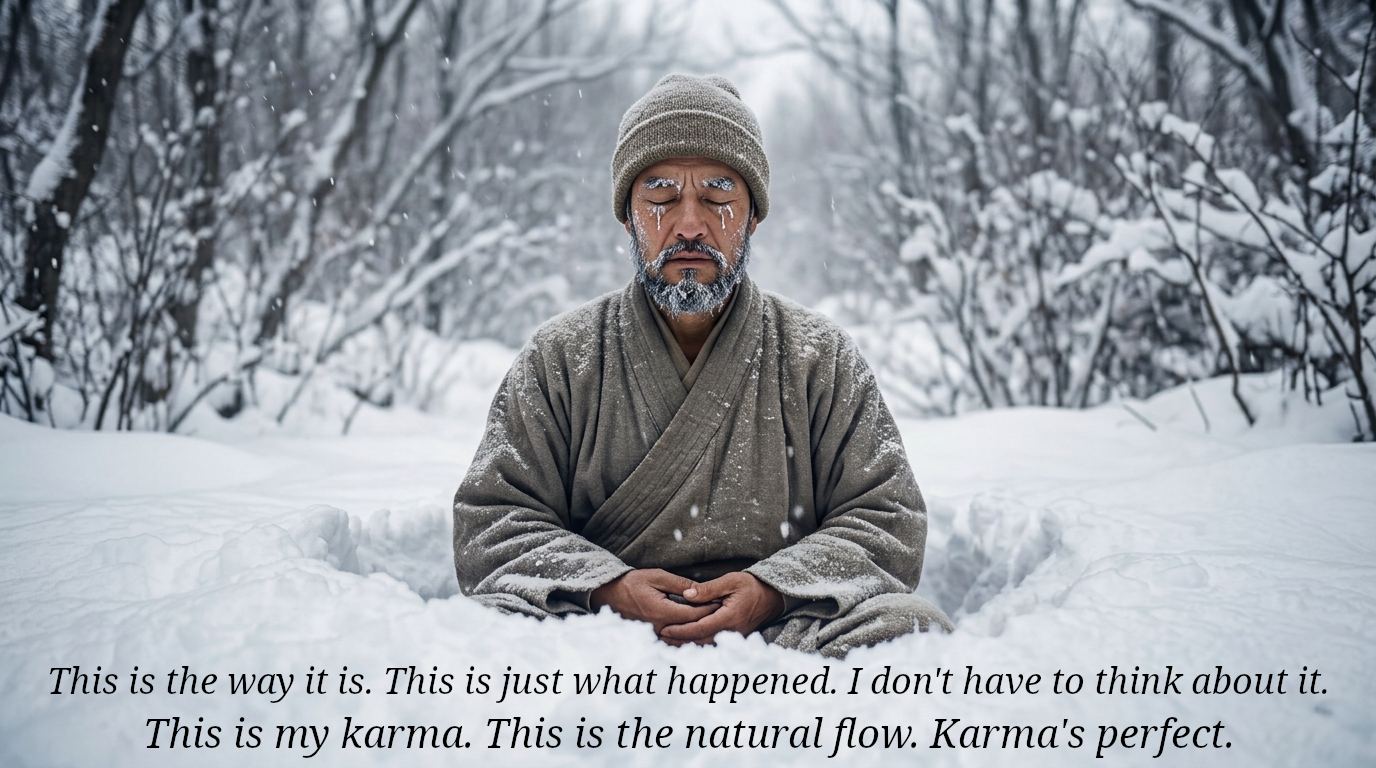
He went on this journey again and finally found Bodhidharma. At this point, Bodhidharma was not necessarily in the cave; he was in a small sanctuary where they lived. It was deep winter, and Huike approached the dwelling of Bodhidharma. There was a little window, and he looked in and could not bring himself to interrupt Bodhidharma, so he stayed outside of the hut, waiting for Bodhidharma to emerge. It started to snow, but he could not bring himself to either go in or leave. So he just sat there in the snow as it built and built up, basically up to his chest in the snow, waiting. The ice melted on his head and froze his eyes partially shut, so he was looking at Bodhidharma through this ice. It was all very torturous.
Finally the next day, Bodhidharma emerged and said, “Who the hell are you? What’s going on here?” Huike said, “Oh, I’ve been sent here through my teachers and celestial beings and I…” Bodhidharma said, “Okay, but why are you here?” He replied, “Well, I’ve come to understand the great compassion that will save all sentient beings.” Bodhidharma looked at him, sized him up, and said, “Yeah, that’s not going to happen. You really need a lot of positive karma and deep teachings and deep understanding to understand the teachings of compassion, and you just don’t have positive karma. And you’ll never understand compassion and you’ll never be of any use to anyone. And on top of that, you’re far too arrogant. So you can go now.”
On top of all the pain and suffering this young man had endured his whole life, here was the greatest Zen teacher of the time telling him he was completely worthless. It just destroyed him. But he was not to be deterred. He wanted to prove that he was worthy of the teachings. So he took a sword and cut off his left arm to prove himself. He lay there bleeding in the snow for a while, and eventually Bodhidharma said, “Oh, you’re such an idiot, come on inside.” And he took him as a student. Huike trained under Bodhidharma for eight years before he went out to continue his journey.
Now, hearing about someone in so much pain and suffering receiving that kind of insult, our first reaction might be, “Man, what a jerk Bodhidharma is. Give this guy a break.” The fact of the matter is, he was giving him a break. He was giving him the deepest compassion teaching he possibly could. What Bodhidharma saw was this person’s true nature, and he saw the teaching that Huike needed to have that none of his previous teachers could have given him. Could Roshi explain to us in greater depth what that is? No, because he is not Bodhidharma, nor is he Huike. There is something that happens in that moment when Bodhidharma can see into the very deepest soul of Huike and see what is required, seeing his true nature, and vice versa. This is a relationship between the best students and teachers, which is inexplicable, and we only know that it is true by the results afterwards.
Roshi noted that when we look at the Western tradition, the Abrahamic tradition, there is a tendency to venerate pain and suffering as some kind of testament to one’s devotion. In the Old Testament, they become prophets; in the New Testament, they become saints who died for their faith. How devoted were they? How wonderful is this? Then we tend to think chopping off an arm is the exact same thing. In reality, it is not. Yes, at the initial level, showing that degree of dedication is an impressive thing. But that is not where Buddhism ends, because simply mutilating your body for the sake of devotion makes no sense in our teaching. It just makes no sense. While in other traditions having that kind of devotion to God or Christ is seen as the ultimate expression, to us, it only demonstrates an elementary passion required to continue on one’s journey of enlightenment. It seems absurd to us to mutilate the body for no good reason. What Bodhidharma was doing at that point was bringing Huike to a level of understanding compassion so that he could actually be transformative in the lives of others.
They trained together for eight years. Huike, again—his karma being what it was—went off and became a wanderer. For a number of years he wandered, using the tools and the enlightenment that Bodhidharma had taught him. He went from bars to brothels to butchers to fish markets, wandering from place to place, experiencing the pain and suffering of others and his own karma. He would get beaten up all the time, robbed, having a really rough time. But the rough time he had then was different from the rough time he experienced before meeting Bodhidharma. Rather than the torment, pain, and suffering being an end unto itself, he learned that pain and suffering creates compassion, and he learned how to transform pain and suffering into compassion and wisdom.
Many of us are still in that stage where we have all these things bothering us every day, but we haven’t quite figured out how to use that as a tool to create more compassion and wisdom in our lives. We just sit in the difficulty and feel bad about it. That is why we need to continue our practice. But for Huike, he learned that all the things happening to him were transformative, that he could actually turn them into positive things for others. His karma was such that his journey was one of pain and suffering, but it was not a journey of being trapped in pain and suffering. It was a liberation from pain and suffering through the pain and suffering.
Finally, after nine years of this, he came to a point where he was able to start teaching, and he taught as he wandered. None of this changed his karma; his karma was one of pain and suffering for his whole life. He came to one village and sat teaching the Dharma. In that group was a local Zen master from the village who became very angry because everyone was coming to listen to Huike give his teisho, and no one was coming to listen to him. Having connections with the local government, he went to them and made up a story about Huike out of jealousy. And they wound up executing Huike.
This is our second patriarch. We think we have it rough—for Huike, it was literally from before he was born until the very end.
The point is, that dynamic and relationship between the teacher and the student is really deep and mutually beneficial. Bodhidharma had no interest in having students. He never tried, unlike many other patriarchs who became enlightened and gathered followers, temples, and movements. Bodhidharma had no interest in that. But through Huike’s intensity—cutting off his arm—Bodhidharma realized, “Oh, this is my student. I have no choice.” So he fulfilled his mission and his karma of becoming a patriarch through Huike. If that had not happened, he might never have had a student, and Zen practice theoretically could have ended there. As it turns out, Bodhidharma had three more students after Huike, about whom we know some historical details, one of whom was a woman, a wonderful teacher. Bodhidharma and Huike fulfilled each other’s destiny in a really interesting way. That is how Bodhidharma became the first patriarch and Huike became the second patriarch. Awful as it was that Huike suffered even more through his teaching, he finally had students who would carry on the lineage.
We have this vision of what a Zen teacher or what our lives should be, but it is never quite what we think it should be. It is a much deeper process and a more fascinating dynamic. Again, it teaches us that suffering is not an end unto itself. That is not why we are on this earth. It is not about just suffering and hoping heaven will be better or that we will be rewarded afterwards; that seems absurd to us. It is about wisdom. How do we cultivate wisdom? How do we cultivate compassion? If our karma brings whatever suffering we are experiencing at this moment, that is our karma. That is our tool. That is what we are supposed to be using to cultivate compassion and wisdom. We cannot complain about it. Roshi noted that if Huike had a choice, he surely would have preferred a different set of cards. But those were the cards dealt; that was his karma. Yet he used it to deepen his understanding, and it was ceaseless—it never ended. And that is okay. After his work with Bodhidharma, he realized, “Okay, this is my karma. This is my life and this is how I’m going to transform myself and all those that I have contact with.”
It is a fascinating, deep teaching, and Huike is a fascinating patriarch for us to have—not just because he suffered, but because of how he transformed suffering, showing how we all can transform the suffering in our lives into wisdom and compassion. With each of the patriarchs, there is a kōan, which is basically a record of an actual experience or exchange they had, a little different from many other kōans that are more puzzling. The case study in this one is the conversation that took place between Bodhidharma and Huike on the day they met. That is the kōan, and this is how the conversation went:
One day Eka, which is Huike’s original name, Light, said to his master Bodhidharma, “My mind is not influenced by the objective world.” Then Bodhidharma said, “Does that mean your mind is not working?” Eka replied, “No, that is not the case.” Bodhidharma asked, “How can you prove it?” Eka replied, “I’m always clear-minded, so words are not necessary to describe it.” Bodhidharma said, “This is the mind of all Buddhas, so there is no doubt in that mind.”
In explaining this, Roshi pointed out that there are different translations. Here it says, “My mind is not influenced by the objective world.” In other translations it is rendered as, “I have overcome my karma. I no longer live in karma,” which is an absurd thing to say because no one overcomes karma. We know this from taking our vows: we disavow our ancient past karma, but even so, we are asked during the ceremony, “Will you keep practicing? Even after you become enlightened, will you keep practicing?” And we all reply, “Yes, I will. I will never stop,” because karma never stops influencing us. We are always in a state of cause and effect; we cannot escape it. So it is a little ironic that Huike says he is clear-minded and has escaped karma, knowing full well that he has not. Bodhidharma responds, “Well, are you an idiot? Like is your mind not working at all? Are you stupid? You say your mind’s not working. Is your mind dead?” Do you really think you are not influenced by karma, that you have escaped it? And Huike replies, “No, that’s not what I’m saying. Saying karma exists, but I have no ideas about karma anymore. That’s why I’ve escaped it. So I live in it in the moment, but I have no conceptions of it. I have no ideas about it. I don’t think about it. I’m in the moment. I just deal with it.”
That represents a very elevated level, because many of us are still struggling with thoughts like, “Why did this bad thing happen to me? What am I going to do with this? Is this my parents’ fault? Is it the neighbors’ fault? Is it my fault?” We are always trying to figure out our karma, the cause and effect of our lives—why these things are happening, what we are supposed to do about it, and how we can make it work. The way we liberate ourselves from it is simply to say, “This is the way it is. This is just what happened. I don’t have to think about it. This is my karma. This is the natural flow. Karma’s perfect. The thing that happened to me had to happen to me. Why do I know it had to happen to me? Because it did happen to me. The things I’m going through right now had to happen to me. Why? Because they did happen to me. It’s perfect, and I’m perfect. Now I’m going to deal with the situation. What’s my move? All right, now I’m going to do this. Based on my understanding of karma, myself, wisdom, and compassion, I believe this is the next thing I should do.” That becomes the next thing to do—to be purely in the moment, reacting to our karma and to circumstances as they arise. That is how we liberate ourselves from it. To which Bodhidharma says, “You’re a Buddha.” That is the way we do it.
Particularly in troubling times, it is a very useful tool.
Leave a Reply