Returning to Keizan’s Denkoroku and its transmission cases through the ancestral lineage, Tesshin Roshi took up the thirty-first patriarch—and fourth Chinese ancestor—Dōshin.
Roshi shared the case:
The thirty-first patriarch, Dōshin, made prostrations to the great master Kanchi Sosan and said, “With your compassion, please show me the dharma gate of liberation.”
Sosan said, “Who is keeping you from it?”
Dōshin responded, “No one is keeping me from it.”
Sosan told him, “Then why do you need me to show you the dharma gate of liberation?”
At that moment, Dōshin was enlightened greatly.
Roshi observed that this dialogue follows a familiar pattern found across Zen literature. A student approaches an adept claiming to be burdened or bound; the teacher asks the student to present or identify the source of the affliction; the student realizes nothing is holding them, and liberation occurs. This echoes the previous case of Sosan himself, who approached his teacher asking to be cleansed of his faults, only to discover that nothing of the sort could actually be found.
Dōshin lived during a period of intense political and social upheaval in China. Among the many legends surrounding him is the account of a defenseless village threatened by bandits. Dōshin taught the villagers the Heart Sutra. When the invaders approached the walls, the entire community chanted the sutra with such unified conviction that the marauders were struck with awe and retreated.
Another well-known story concerns the emperor summoning Dōshin to court. Dōshin repeatedly declined the invitations. Eventually, an envoy was dispatched with orders to either bring the master or return with his head. When delivered the ultimatum, Dōshin simply stretched out his neck in readiness. Recognizing Dōshin’s absolute fearlessness and authenticity, the officer relented and reported back to the emperor, who thereafter left the master in peace.
Roshi noted that such encounters can lead practitioners to believe that Zen requires complete ascetic detachment or an outright rejection of worldly resources and influence. However, this is a misunderstanding. Zen practice encompasses everyday reality, including work and material necessities. Even during Shakyamuni Buddha’s time, hundreds of stūpas and monasteries were constructed because kings and lay followers were moved to support the sangha.
Fulfilling the bodhisattva vow to alleviate suffering requires practical means. Temples, heating, electricity, and facilities cannot exist without financial support. Roshi referenced his own teacher, Ban Roshi, who taught that practitioners must direct their primary attention to practice, integrity, and values, trusting that karma and cause-and-effect will cause the necessary conditions to fall into place.
Addressing the development of Zen in the West, Roshi pointed out that genuine practice cannot retreat into an idealized cave. Establishing rigorous training centers and monasteries requires engagement with real-world logistics, management, and community responsibility. The sacred is not found by running away from everyday life or employment, but by realizing it directly within one’s work—whether as an accountant, an attorney, or a tradesperson.
Returning to the kōan, Roshi examined what Sosan and Dōshin were actually addressing. Whether an obstacle appears as a physical affliction or an abstract yearning for freedom, fundamentally its nature is mu, kū—empty.
Roshi invited the sangha to recall their very first days of sitting zazen and the pressing existential dilemmas that felt overwhelming at the time. Looking back years later, those once-consuming dilemmas often appear like an awkward old photograph—hardly as monumental as they seemed.
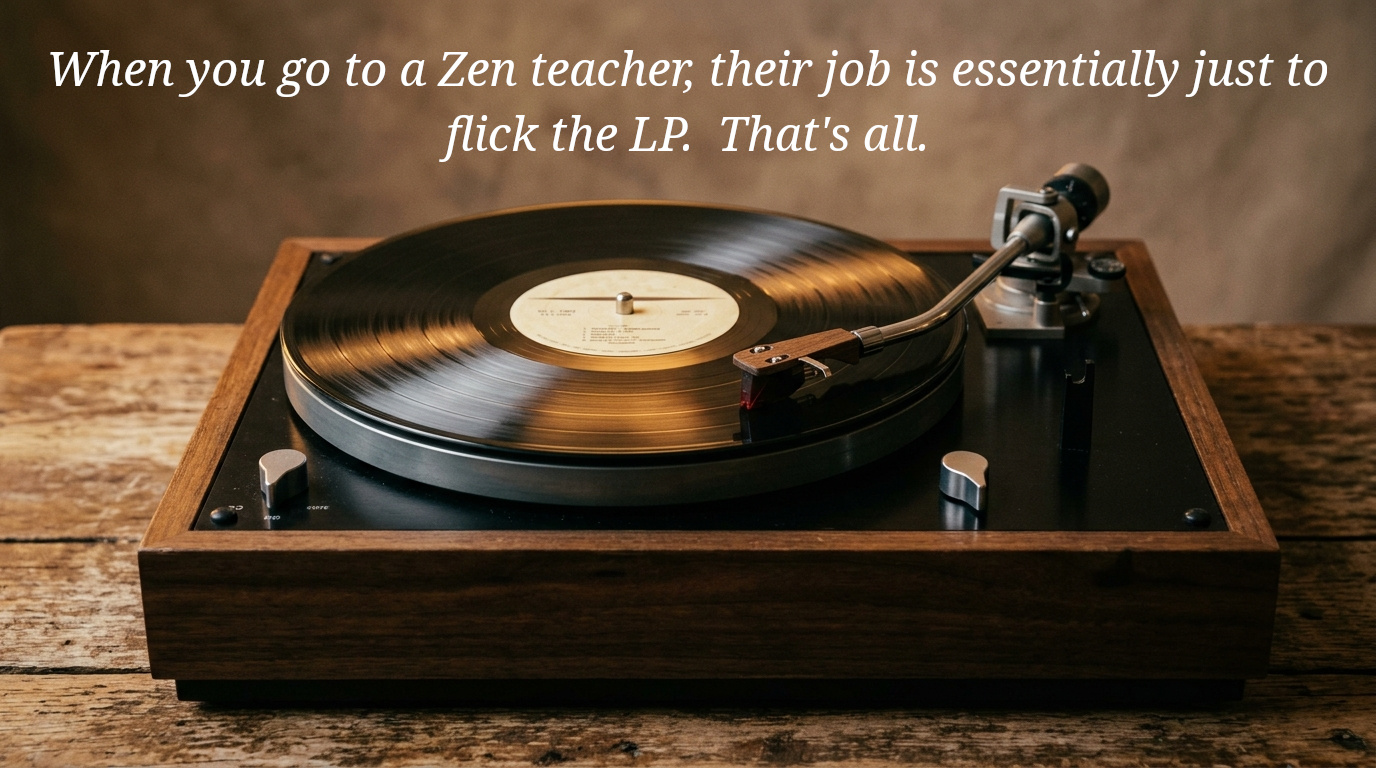
In this sense, a Zen teacher has nothing inherently new to give, nor does a student have anything missing to acquire. Roshi likened the teacher’s role to nudging the needle of a scratched record that is stuck playing the same groove over and over. When a practitioner is caught in a repetitive loop of anxiety, grievance, or existential dread, the teacher does not resolve an objective problem, because no fundamental obstruction actually exists. Instead, through the discipline of practice, dokusan, and the kōsaku, the teacher simply flicks the needle so the music can proceed. Over time, as this process continues, the practitioner draws closer to total freedom, uncovering their true nature and stepping beyond habitual fixations.
In closing, Roshi shared the verse left by Dōshin from the Denkoroku:
“Again, I have some humble words. Are you ready to listen? Mind, emptiness. Purity and knowledge have no discrimination. What binds you? Even if there are four elements and five skandhas, seeing and hearing, sound and form are nothing, and nothing is true mind.”
Leave a Reply