Tesshin Roshi continued the series on the six Chinese patriarchs in the Denkoroku, the collection compiled by Keizan Zenji recording the transmission between masters and disciples. Huineng is the thirty-third ancestor in the lineage and the sixth and final Chinese patriarch. Numerous foundational Zen teachings stem from Huineng, not least of which is the Platform Sutra. Roshi emphasized that rather than glossing over these stories, the sangha will delve deeply into these teachings going forward, as so many of them form pivotal cases in our koan collections.
Huineng was born to a very poor family. His father, a laborer cutting timber, was sent south on an assignment and had to leave the family behind. Raised alone by his mother, Huineng had to work from an early age chopping and selling firewood in town. Through this physical labor—immersed in nature and working diligently at his chores—he developed an innate sensitivity and wisdom. One day in town, while selling wood, he overheard a monk reciting the Diamond Sutra, which struck him to his core. In that moment, he resolved to pursue the path of wisdom and began training and practicing on his own.
On another occasion while selling wood, Huineng came across a nun discussing the Dharma. When he commented on a passage to the assembled adults, the nun was taken aback and asked, “How did you have that understanding of this teaching?” Huineng was illiterate and had never read the text; he had only heard it spoken. He simply replied, “Well, it’s just natural. It’s just the way the universe is.” Recognizing his insight, the nun questioned him further and discovered his natural awakening. She suggested, “We have this abandoned temple in the village. Why don’t we fix it up and install you there, and you can teach everyone this stuff?” The villagers did so, and Huineng became a very young teacher. However, he soon realized that sitting there expounding what was already obvious to him was not the culmination of the path, so he decided to leave.
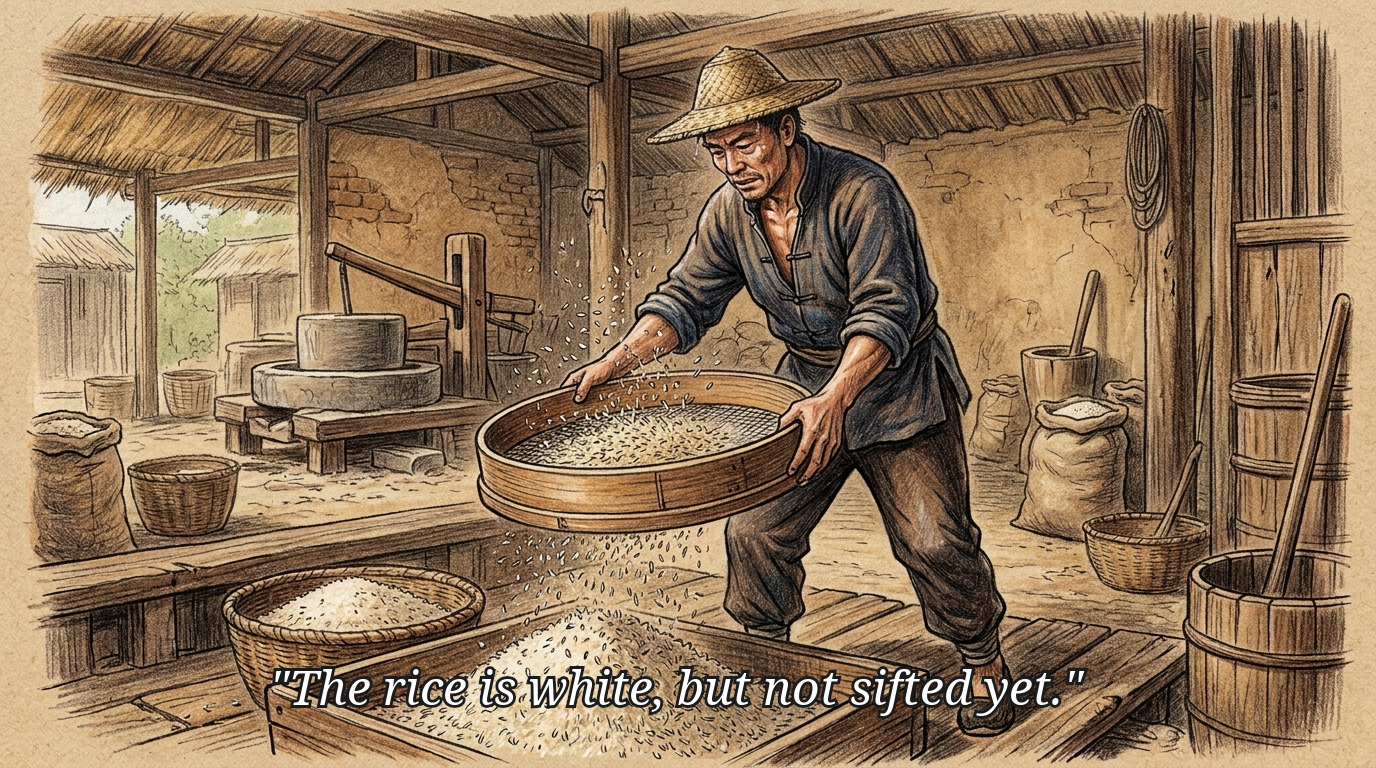
Someone then directed him to a teacher of meditation, a discipline with which he was unfamiliar. Huineng trained with him for a time, and due to the foundation he had already established, meditation came quite naturally. Eventually, he was directed to the great sage Hongren (this is the Chinese name for the patriarch discussed last week, Daiman Konin in Japanese). When Huineng arrived to study, he was not an ordained monk; he was simply a layperson working and practicing at the temple. He was assigned to labor in the mill house, husking the rice, pounding it to strip the hull, and sifting it to produce pure white grains.
One evening, Zen Master Hongren entered the mill house, saw Huineng, and asked, “Is the rice white yet?” Huineng replied, “It is white but not sifted yet.” Hongren then struck the ground three times with his pestle, and Huineng responded by shaking the sifting bamboo tray three times.
To understand this exchange, Roshi explained that we must look at the significance of rice. In Western culture, rice is often seen simply as a staple foodstuff, but in Asia, rice represents life itself. Entire societies have been sustained and built upon rice and bamboo. Rice is even venerated in sacred contexts, such as the ceremonial mochi offerings placed upon shrines during the New Year. Culturally, white rice is treated with immense respect: it is complete and pure in itself. Adding condiments directly onto white rice or altering it is seen as an offense against its nature—much like putting ketchup on breakfast cereal or dipping a fine slice of pizza into chocolate milk. The rice is respected in its essential, pure form.
Within a monastery, husking, polishing, and sifting rice is a vital duty. In Japan, wild rice can still be found growing in untamed patches. In its wild state, it is already whole and complete within the husk, but it cannot yet be eaten. Roshi pointed out that this illustrates our Buddha nature. Everyone possesses Buddha nature; it is inherently complete and perfect within each of us, but it is not yet in a form we can fully actualize. To partake of it, we must pound, sift, and polish it through practice, allowing our true nature to shine forth so that it can be lived and embodied.
Practice does not create something that was not already present. Roshi cautioned against misdirected veneration of teachers, noting that people often praise their teachers as uniquely extraordinary. In truth, there is no such thing as an inherently great Dharma teacher. At best, a teacher is simply a dedicated practitioner who has developed the facility to pass along the Dharma. They have invented nothing original; they are merely vehicles transmitting the teachings from generation to generation. The truth rests in our inherent Buddha nature. When Huineng was asked, “Is it white yet?” he answered, “It is white but not sifted yet.” The essential nature is always present and pure, but the work of cultivation must continue.
Roshi observed that while many spiritual traditions rely predominantly on intellectual study and sacred texts, Zen teaches that all the senses are gateways to awakening. The exchange between Hongren and Huineng was entirely auditory and non-intellectual, free of words and conceptual thought. Just as Shakyamuni Buddha wordlessly transmitted the Dharma by holding up a flower to Mahakasyapa, or the three strikes of the bell signal the start of zazen, sound directly invites us into shared concentration and awareness. The rhythmic pounding of the pestle and the sifting of the bamboo tray formed a wordless, harmonious dialogue of practice.
This encounter is recognized as a moment of transmission between master and disciple. Roshi noted that the tradition preserves several stories of Huineng’s realization, including the renowned koan in which he addresses two monks arguing over whether the wind or the flag is moving. Notably, throughout these profound experiences—and even upon receiving the ancestral robe and bowl—Huineng was not an ordained monk. He remained a lay practitioner, living as a wanderer for over a decade before formally taking monastic vows. This demonstrates that formal status is not the essence of the Dharma; practice is all that matters. Furthermore, due to the intense attachment and rivalry surrounding symbols of authority at that time, Hongren told Huineng, “The robe ends with you. Don’t give it to anyone after this.”
Roshi concluded by reflecting on how Huineng established so much of the bedrock of Zen understanding despite being poor, illiterate, and unordained. Practitioners often place conditions on their practice, believing they need particular circumstances or qualifications before they can awaken. Huineng possessed none of these worldly advantages, yet he became one of the most significant patriarchs in our lineage. Roshi reminds us that it brings us back to, “What are we waiting for?” Huineng’s life leaves the sangha with a direct reminder that there are no excuses, and that practice begins immediately, exactly where we are.
Leave a Reply