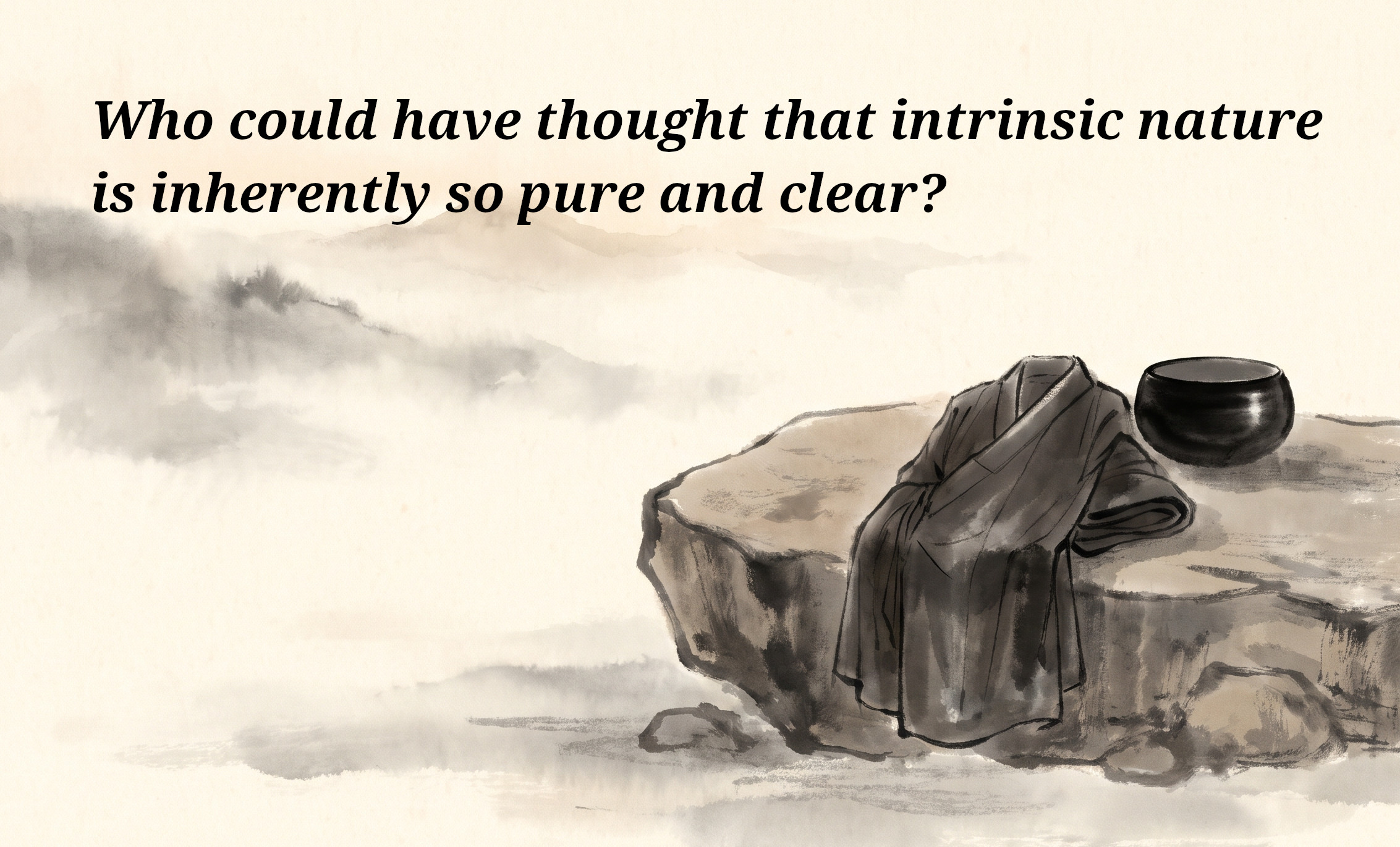
Continuing his talk on the Platform Sutra, Tesshin Roshi revisited the evening when Huineng received the bowl and the robes from the Fifth Patriarch—the first ordination and the teaching lineage establishing him as the Sixth Patriarch. Tesshin pointed out that what one receives in such a moment, arguably far more important than physical objects, is the mind-to-mind transmission of the Dharma. It was that transmission that truly occurred that evening and prompted the giving of the bowl and robe.
Earlier, the Fifth Patriarch had recognized a poem written by Huineng as deeply insightful and summoned him to his room at night to teach him the Diamond Sutra. Although Huineng had already been inspired by the Diamond Sutra in his youth—which had set him on the path in the first place—he now gained even greater insight. At one point, the Fifth Patriarch reached a particular line that broke open Huineng’s mind, giving rise to a teaching that Zen practitioners still rely upon heavily today.
When the Fifth Patriarch came to the line in the Diamond Sutra that said, “Let the mind be present without an abode,” Huineng experienced a profound awakening and realized that all phenomena are not different from intrinsic nature. Directly expressing this deep insight, Huineng spoke five sentences to the Fifth Patriarch (each of which Tesshin repeated for emphasis):
- “Who could have thought that intrinsic nature is inherently so pure and clear?”
- “Who could have thought that intrinsic nature is inherently neither created nor destroyed?”
- “Who could have thought that intrinsic nature is inherently complete?”
- “Who could have thought that intrinsic nature is inherently unmoving?”
- “Who could have thought that intrinsic nature can inherently manifest all phenomena?”
Upon hearing this, the Fifth Patriarch said, “Without knowing the inherent mind, learning the Dharma is of no benefit. One who realizes the inherent mind and sees inherent nature is a person of greatness, a teacher of heavenly and human beings, a Buddha.”
Tesshin explained that this teaching brings together a number of other sutras that clarify Zen teachings going forward. While so many things are phenomena of the mind, the ordinary mind itself is not one’s inherent nature; inherent nature is something much greater. Having a mind that is not attached to any single thing—a mind without an abode—is the true nature of mind. Pain and suffering arise because the mind attaches to the ego or to particular things, yet its true nature has no attachments and no abode.
It was this mind-to-mind transmission—the true understanding of the Dharma of the inherent mind—that led the Fifth Patriarch to recognize Huineng as the Sixth Patriarch and send him away. Tesshin noted that all of the other teachings Huineng set down in the Platform Sutra tie back to this fundamental insight. He then recounted several subsequent incidents leading up to Huineng’s first extensive teaching.
Huineng left as instructed. Another monk named Huiming—a former military general who had given up military life to become a monk—was a large, rough, strong, and intimidating figure. When Huineng’s departure became apparent, turmoil broke out over his succession and disappearance, and Huiming pursued him through the mountains. Huineng, who was illiterate and not particularly strong, fled quickly through the mountains, but as Huiming closed in, Huineng grew frightened. In the famous story, he placed the robe and bowl on a rock and hid behind it.
Tesshin noted that there are two versions of what happened next. In one version, Huiming did not see Huineng, found only the bowl and robe, and tried to pick them up but could not—realizing then that he was in over his head, that Huineng was authentic, and that he had much to learn. Tesshin considered the second version more likely: Huineng saw Huiming approach and told him he could take the bowl and robe, as he neither needed nor wanted them and they were not the point. Huiming replied that he had not come for physical objects, but was pursuing Huineng because of his insight—the very reason he had given up his military life—and that nothing was more important. Seeing Huiming so agitated and passionate, the Sixth Patriarch told him to take a breath, sit down, and relax so they could discuss the Dharma. Tesshin observed that practitioners pursue the Dharma in different ways: some remain calm, while others get intensely excited, and Huiming’s passionate intensity had frightened Huineng.
Once Huiming had calmed down, cleared his mind, and meditated briefly, Huineng felt ready to speak with him about the Dharma. Tesshin shared several translations of Huineng’s famous words to Huiming:
- “Do not think of wholesomeness, do not think of unwholesomeness.”
- “When you are not thinking of evil and when you are not thinking of good, what then is your original face?”
- “What is your face before your parents gave you birth?”
As Tesshin explained, this became one of the great Zen koans: “What is your face before you were born?” It points directly back to inherent nature. When practitioners are able to put down the duality of wholesomeness and unwholesomeness, or good and evil—when they can relax, stop judging everything, let go of attachment to any judgments, and simply be—who are they truly? At that moment, Huiming experienced a deep understanding and insight of his own, which the Sixth Patriarch recognized before sending him on his way. Tesshin added that the Platform Sutra is filled with teachings that resonate throughout Zen literature, and that this koan is one students will eventually work on.
Afterward, Huineng faced a difficult period. That time in China was dangerous for priests, and especially dangerous for Huineng, as others were jealous of his Dharma transmission. Needing a safe place to live for a while, he returned to the forests, where he felt comfortable having grown up cutting wood as a child. There, he found a community of hunters in the woods and stayed with them for fourteen or fifteen years. Tesshin noted how unusual it seemed for a Buddhist practitioner who had taken the precepts to live among people who killed animals. Yet being part of nature was who Huineng was, and even though they hunted, they shared that sense of being part of nature. Wanting to avoid fighting with his community while remaining true to his practice, Huineng acted subtly.
When the hunters went out and asked him to watch certain traps, Huineng agreed, and whenever a trapped animal was caught, he looked around and quietly let it go. Likewise, when they brought back food and he cooked for them, he prepared a lot of vegetables instead of meat. When they asked why he was feeding them vegetables, he told them they could have the meat, but vegetables were good for them. In these subtle ways, he maintained his relationship with the community while bringing in practices aligned with the Dharma—providing a remarkable example of how to keep one’s precepts while staying connected to one’s community over fourteen or fifteen years.
Tesshin remarked that although Huineng was itinerant and occasionally slipped a little Dharma into his interactions, his time there was primarily about maintaining connection with the hunters. He compared this to his own experience at Tetsugyuji, where he was surrounded by farmers who had no interest in the Dharma; their lives revolved around planting rice, so one spoke with them about rice planting and hoped a little Dharma might sneak in along the way.
Eventually, Huineng left the forest and found his way to a large, famous temple called Faxing Temple in Guangzhou. On the day he arrived, a young visiting priest was teaching a very old sutra to a crowd of monks and priests. Temples typically have banners and flags everywhere, and as Huineng humbly approached, he saw two monks debating a moving flag. One monk argued that the wind was moving the flag, while the other insisted that the flag was moving the wind. After listening quietly as they debated back and forth, the Sixth Patriarch—just as he had done long before with his poem at the monastery—finally stepped in and told them they were both wrong, stating that the mind is moving both the flag and the wind. In doing so, he went right back to the principle that the mind is what perpetuates and creates reality.
The visiting priest teaching the sutra overheard this exchange and realized that Huineng was a true master while he himself was not. He invited Huineng inside and offered him the seat to teach. This marked the first time the Sixth Patriarch delivered an extensive, profound teaching.
Tesshin concluded by noting that even within this brief period of Huineng’s life, two classic Zen koans emerged: the inquiry into one’s original face before birth, and the exchange demonstrating that neither the wind nor the flag moves, but the mind.
Leave a Reply